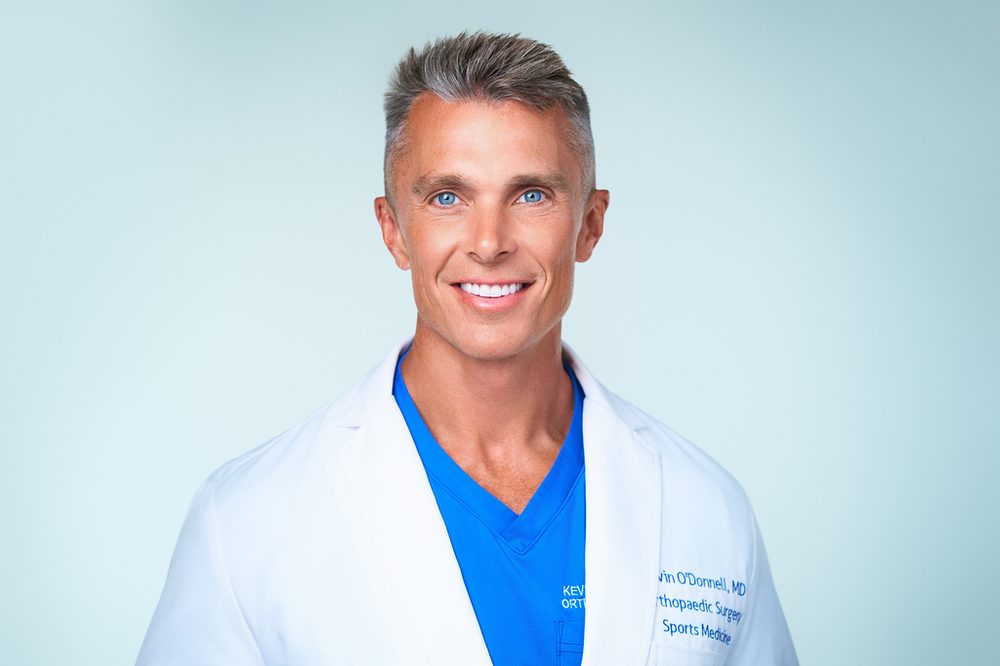
Dr. O'Donnell treats the full range of shoulder problems: rotator cuff tears, dislocations and recurrent instability, labral and SLAP tears, biceps tendon injuries, impingement and bursitis, frozen shoulder, AC joint separations, clavicle and proximal humerus fractures, and arthritis. His patients include University of Miami athletes, overhead and contact athletes from high school through masters level, and adults in Coral Gables and Miami whose shoulder hurts at night, will not lift overhead, or has slipped out of joint.
The first visit establishes what is torn and whether it will heal. Exam findings and X-rays are usually enough to start treatment; MRI is ordered when a full-thickness cuff tear, a labral tear or a bone defect after dislocation would change the plan. Most shoulders are treated without surgery: a defined course of physical therapy, activity modification and, where pain is blocking progress, an ultrasound-guided injection. When surgery is the better option, Dr. O'Donnell operates arthroscopically wherever the anatomy allows, including rotator cuff repair, Bankart and labral repair, biceps tenodesis and subacromial decompression. Fractures that have displaced are usually plated; advanced arthritis that limits daily life despite non-operative care is treated with an anatomic or reverse shoulder replacement, chosen on the state of the rotator cuff.
Rehabilitation after every operation follows Dr. O'Donnell's written protocols, which set sling time, motion limits and strengthening on criteria rather than dates, and the same protocols are given to patients treated without surgery. Surgery is performed as an outpatient at Bayside Surgery Center in Coconut Grove; patients from outside South Florida can upload imaging through mymedicalimages.com and arrange telemedicine consults and post-operative visits.
When to see a specialist
Shoulder pain after a fall, a throwing session or a night of poor sleep often settles within two weeks with rest and anti-inflammatories. The signs below do not settle on their own and should be examined the same week:
- The shoulder came out of joint, or partly out, even once
- Sudden weakness lifting the arm to the side after an injury, with or without a tearing sensation
- A visible bump at the top of the shoulder or over the collarbone after a fall
- Night pain that wakes you or stops you lying on that side for more than three weeks
- Progressive loss of motion, especially reaching behind your back or turning the arm out
- Numbness or tingling in the arm or hand with the shoulder pain
How Dr. O'Donnell decides between rehab and surgery
The decision turns on what tissue is injured and whether it can heal in place. Tendon that has pulled off bone does not reattach on its own, so an acute full-thickness rotator cuff tear in an active patient under about 65 is usually repaired early, before the tendon retracts and the muscle turns to fat; partial tears and small degenerative tears are rehabilitated first, with surgery reserved for those still weak or painful at 3 months. A first dislocation in a contact or overhead athlete under about 25 usually recurs, so stabilization is offered after the first event; a first dislocation over 30 is treated with rehabilitation.
Pain without a structural defect is treated without surgery for a full course before any operation is considered. Impingement and bursitis and frozen shoulder improve with therapy and an ultrasound-guided injection in most patients, and Dr. O'Donnell does not operate on either until at least 3 to 6 months of correct treatment has failed. Fractures are decided on X-ray alignment and the patient's demands: a displaced clavicle or proximal humerus fracture in an active adult is usually fixed; an undisplaced one is not. A cuff tear or labral change on an MRI is not by itself a reason to operate, since both are common in shoulders that do not hurt; surgery is recommended only when the symptoms, the exam and the imaging agree, as explained in What an MRI Finding Means.
Shoulder conditions we treat 10
Shoulder procedures 8
Rehabilitation protocols
Dr. O'Donnell's written physical therapy protocols for this joint, shared with your therapist and progressed on criteria rather than dates.
Frequently asked questions
How do I know if my shoulder pain needs surgery?
Surgery is likely when there is a structural injury that will not heal on its own: a full-thickness rotator cuff tear with weakness, a dislocation in a young athlete, a displaced fracture, or arthritis that has failed injections. Pain alone, without weakness or instability, is treated with therapy and an injection first, and most patients improve within 6 to 12 weeks. An exam and, when needed, an MRI settle the question.
Do I need an MRI for shoulder pain?
Not at first. Exam and X-rays separate most causes of shoulder pain and guide the first six weeks of treatment. An MRI is ordered when weakness suggests a rotator cuff tear, after a dislocation to assess the labrum and bone, or when pain has not improved after a proper course of therapy. If you already have one, upload it through mymedicalimages.com before your visit.
Can I be seen the same week after a shoulder injury?
Yes. Same-week appointments are kept for acute injuries, including dislocations, suspected cuff tears, and clavicle or shoulder fractures. Bring any X-rays from an urgent care or emergency department, or upload them in advance. Early assessment matters most for tendon injuries and fractures, where the best repair window is the first few weeks.
How long is recovery after arthroscopic shoulder surgery?
It depends on what is repaired. After a subacromial decompression the sling comes off within days and most patients are back at a desk within a week. After a rotator cuff repair or stabilization the sling stays on for 4 to 6 weeks, strengthening starts around 3 months, and return to contact or overhead sport is about 6 months.